
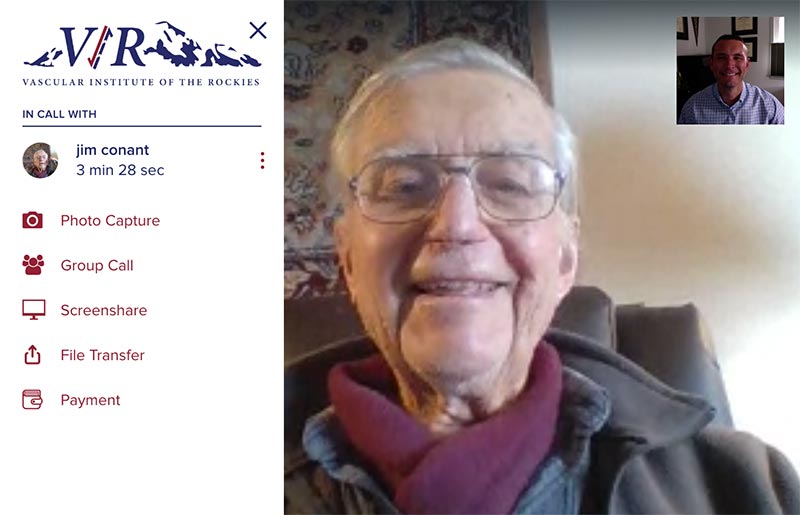
Thanks for the opportunity to meet Dr. Garland on a telemed call! My visit with him on the call seemed just as personal as if I’d been in his office. We had a nice, relaxed chat about my upcoming surgery. I was very comfortable at home with my laptop on my lap, talking to him as though he was in the room with me. I was glad I didn’t have to go to his office. I’m 93. The call came on right at the agreed-to time. No waiting in a doctor’s office and exam room.
I set up my laptop for the call just by going to vascularinstitute.com and clicking on “Services>telemedicine.” Dr. Garland was able to show me my latest CT-scan and show me pictures to explain what he needed to do to correct a problem in my abdominal aorta. We had time to get to know each other a little, too.
I highly recommend telemedicine as a personal, efficient way to deliver medical care to me at home. I enjoyed my call with Dr. Garland. I think he did, too.
– Jim, VIR Patient
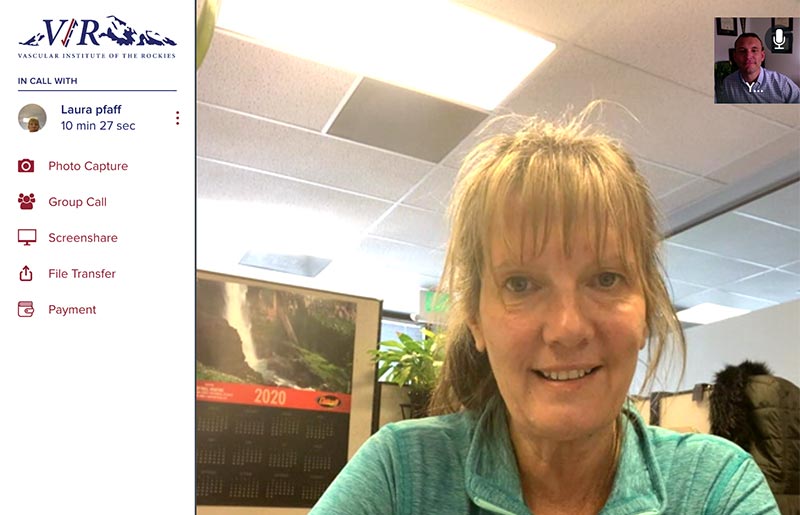
Just had my first telemedicine meeting with Dr. Garland at VIR. I have to say I was very pleased at how EASY it was to go to a website, click on the doctor from a drop down option, enter your name and click Check-In. That’s it – so simple. It was a great time saver from not to have to drive, park, walk in and then wait. All it take is a few minutes to be sitting in the comfort of your own home or office and your appointment starts ON TIME. In a time when we are all trying to social distant, this telemedicine is the BEST way to keep all safe and still be able to move forward with medical needs. Definitely advise you to give it a try, I do hope this is going to be the new normal way to communicate when necessary.
Thanks VIR and Dr. Garland for my visit.
– Laura, VIR patient
our provider may recommend an echocardiogram if you have symptoms that suggest a heart condition or if another test indicates that additional evaluation is needed. It is also frequently used to monitor patients with known cardiovascular disease and evaluate how well treatments are working over time.
Your provider may also order an echocardiogram before certain surgeries or procedures to better understand your heart function and determine whether any additional precautions are needed.
An echocardiogram provides detailed information about many aspects of heart health that cannot be determined through a physical exam alone. The images help your provider evaluate both the structure of your heart and how effectively it is pumping blood throughout your body.
A standard transthoracic echocardiogram is performed in a comfortable outpatient setting and usually takes between 30 and 60 minutes. The exam is painless, requires no incisions, and most patients can resume normal activities immediately afterward.
Preparation – You’ll change into a gown, and small adhesive electrodes may be placed on your chest to monitor your heart rhythm throughout the examination.
Image Collection – A cardiac sonographer will apply a warm gel to your chest and gently move a handheld ultrasound transducer across several areas. The sound waves create detailed images of your heart that appear instantly on a monitor.
During the exam, you may be asked to briefly hold your breath or change positions to allow additional views of the heart.
After the Test – Your provider may ask you to briefly change positions or hold your breath so additional images can be captured from different angles.
Once the exam is complete, you can immediately return to your normal daily activities.
Different types of echocardiograms may be recommended depending on your symptoms and medical history.
Transthoracic Echocardiogram (TTE) – The most common type of echocardiogram, performed by placing an ultrasound probe on the chest.
Stress Echocardiogram – Images are taken before and after exercise or medication that increases your heart rate to evaluate how your heart performs under stress.
Transesophageal Echocardiogram (TEE) – A specialized ultrasound probe is passed into the esophagus to obtain highly detailed images of the heart when additional visualization is needed.
Your provider will recommend the test that best fits your condition.
After your test, your cardiovascular specialist carefully reviews the images and measurements.
Your physician will explain the findings, discuss whether additional testing is needed, and recommend the next steps for your care.
An echocardiogram is one of the safest and most informative diagnostic tools available in cardiovascular medicine. It provides detailed information while remaining comfortable and convenient for patients.
Noninvasive and Comfortable – No surgery, needles, or incisions are required for a standard echocardiogram, making it a low-risk diagnostic procedure.
Radiation-Free Imaging – Unlike CT scans or certain other imaging tests, echocardiography uses ultrasound rather than radiation, making it safe for repeated evaluations when needed.
Real-Time Heart Function – Providers can watch your heart beating in real time, allowing them to evaluate pumping strength, valve movement, and blood flow during the examination.
Early Detection of Heart Disease – Many heart conditions can be identified before symptoms become severe, allowing treatment to begin earlier and potentially improving long-term outcomes.
Personalized Treatment Planning – The information gathered during an echocardiogram helps your cardiovascular specialist make informed decisions about medications, additional testing, lifestyle recommendations, or interventional procedures.