
Authored by: Emily Gudvangen Sherwood, OMS III and Bryan Kramer, MD
What is renal artery stenosis?
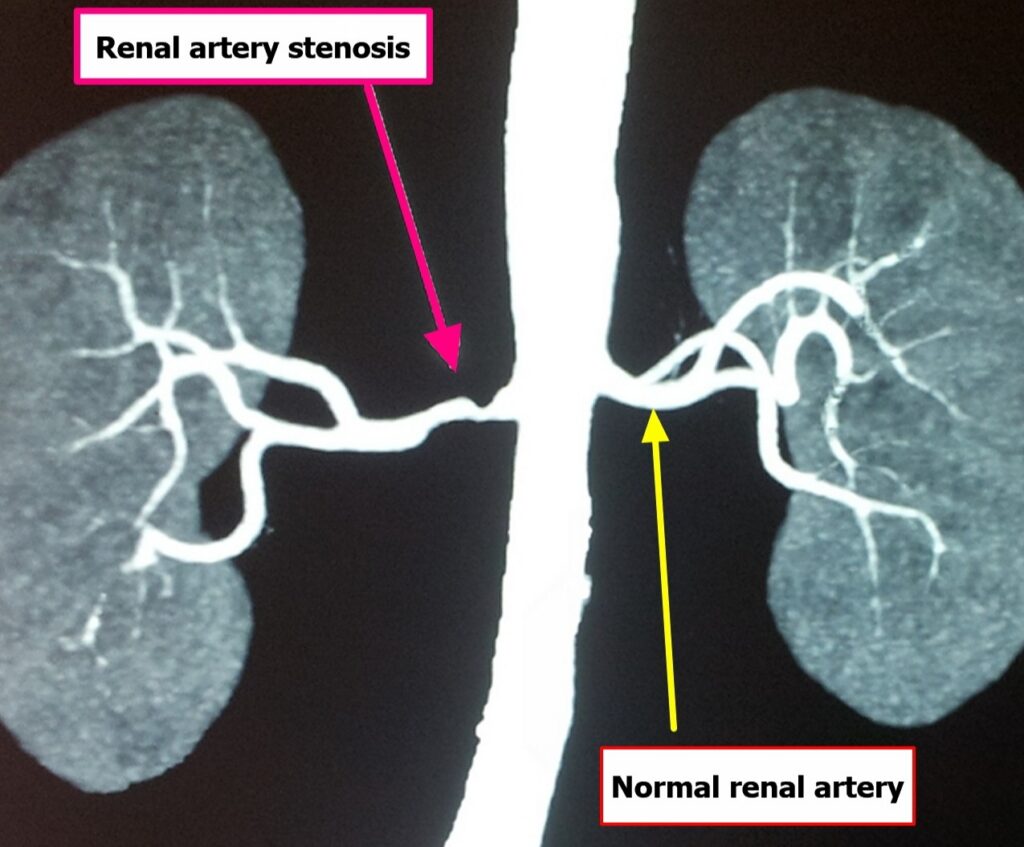
Renal artery stenosis refers to narrowing of the renal arteries, which are the arteries leading to the kidneys. This narrowing usually occurs due to a buildup of atherosclerotic plaque. The plaque buildup can affect the blood flow reaching the kidneys and, in some cases, can diminish the blood flow enough to cause chronic kidney disease and hypertension.
Who should be screened for renal artery stenosis?
- Patients with a progressive and persistent reduction in GFR and a lack of evidence supporting alternative kidney disease.
- Severe hypertension that is treatment resistant to three anti-hypertensive medications.
- Acute rise in serum creatinine after administration of ACE inhibitors or ARBs.
- Unilateral small kidney or asymmetry in kidney size by more than 1.5 cm that cannot be explained by another reason.
- Recurrent episodes of flash pulmonary edema and/or refractory heart failure.
How is renal artery stenosis diagnosed?
Renal arteriography is the gold standard for diagnosing renal artery stenosis. Renal arteriography is a special type of x-ray picture that helps doctors visualize the vessels in the kidneys. This involves putting a needle in a large artery in the groin area and advancing a catheter into the large artery leading to the kidneys. When the catheter is in place, a dye is injected and an x-ray picture is taken.
Because this is a more invasive procedure, there are other less invasive techniques that are also acceptable including ultrasound, CTA, and MRA.
Who should be treated for renal artery stenosis?
- Patients should be considered for treatment of renal artery stenosis if their kidney function is being affected by the occlusion, which usually requires an occlusion of at least 60-75% of the arterial lumen.
- Before treatment, the providers should consider whether the condition of the kidney would benefit from restoration of blood flow, which may require further testing such as a kidney biopsy.
- Patients with hypertension which is uncontrolled on three medications are most likely to benefit from treatment of renal artery stenosis
What is the treatment for renal artery stenosis?
- All patients with renal artery stenosis should be on medication to control their hypertension in addition to routine CKD care and surveillance. They should also be treated aggressively for their atherosclerotic cardiovascular disease for secondary prevention of cardiovascular morbidity. This includes aspirin, statins, cessation of smoking, and glycemic control in those with diabetes.
- In addition to medical therapy, some but not all patients should undergo revascularization, depending on the hemodynamic severity and likely recoverability of kidney function, or hypertension uncontrolled on three drugs.
Resources
Textor , Stephen. “Clinical Manifestations and Diagnosis of Chronic Kidney Disease Resulting from Atherosclerotic Renal Artery Stenosis.” Www, www-uptodate-com.proxy.rvu.edu/ contents/clinical-manifestations-and-diagnosis-of-chronic-kidney-disease-resulting-fromatherosclerotic-renal-arterystenosis?search=renal+artery+stenosis.
Read More from CardioVascular Institute of The Rockies
Who Is Most at Risk for Fibromuscular Dysplasia?
Keeping your blood vessels healthy is one of the most important steps you can take to live a long, healthy life. Along with eating a
What are the Complications of Endovascular Aneurysm Repair?
When your blood vessels aren’t healthy, your overall well-being is put into jeopardy. In fact, many vein and artery conditions can lead to life-threatening complications,
Can a DVT Go Away on Its Own? What You Need to Know
Being diagnosed with a blood clot can be a scary experience. While some blood clots are a normal part of your bodily function and will
What Does Claudication Feel Like? Causes and Symptoms
What does claudication feel like and what are the most common causes? When your arteries are not healthy, your overall quality of life can be
Geniculate Artery Embolization (GAE) for Knee Pain Relief
By Monika Neale, MS III GAE – POSSIBLE NEW SOLUTION FOR SOME KNEE PROBLEMS The network of the geniculate arteries comprises six arteries that supply
Arterial vs. Venous Ulcers of the Lower Extremity
By Monika Neale, MS III The two most common types of lower extremity wounds are venous and arterial ulcers. Although they may look and sound