
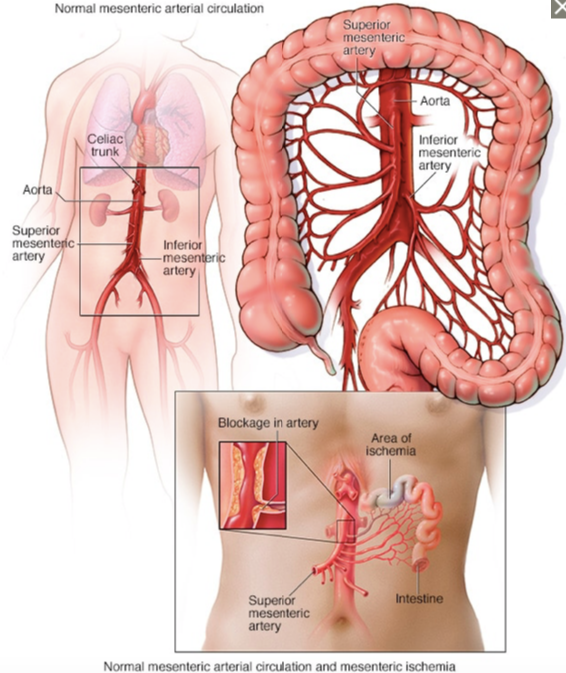
Photo of Mesenteric Ischemia obtained from The Mayo Clinic
Authored by: Zuyuan (Milly) Huang, MSIV and Bryan Kramer, MD
What is Mesenteric Ischemia (Ischemic Bowel Disease)?
Mesenteric arteries supply blood to your small and large intestines. Ischemia is when the blood flow is restricted or reduced to a part of the body. In mesenteric ischemia, the intestines do not get enough blood (and thus, oxygen) to function and can die. This condition is most commonly seen in those older than age 60 with risk factors include smoking, vascular disease, and atrial fibrillation.
What are the symptoms of Mesenteric Ischemia?
This condition can be acute (abrupt start of symptoms) or chronic (had the condition for a long time).
Acute symptoms:
- Sudden, severe mid to upper abdominal pain typically after eating- SICK!
- Nausea, vomiting, sudden bloody diarrhea
- Since this condition is serious and can worsen quickly (mortality rate exceeding 60%), it is critical to go to an emergency room to seek medical attention immediately.
Chronic symptoms:
- Severe pain in mid to upper abdomen starting about an hour after eating, lasting about two hours before disappearing. Big meals make the pain worse.
- Unintentional weight loss
- ALL patients with chronic mesenteric ischemia are THIN and getting thinner
- Food aversion due to pain; feeling full too quickly when eating.
What causes Mesenteric Ischemia?
Most common causes include:
- Blood clot, called an embolus, travels to mesenteric arteries obstructing blood flow. These clots usually originate in the heart in patients with atrial fibrillation (irregular heart beat), or other heart disease (i.e., valvular)- ACUTE
- Atherosclerosis due to plaque buildup, which causes arteries to become narrow and stiff, and thus slowing blood flow through them. Atherosclerosis is caused by many chronic conditions such as high cholesterol, high blood pressure, smoking, obesity, diabetes and inflammatory conditions- CHRONIC
- Nonocclusive mesenteric ischemia due to low-flow state (i.e., low blood pressure from Congestive Heart Failure, aortic dissection) or bowel strangulation from hernias, volvulus, etc.- IN THE CRITICALLY ILL, ICU PATIENT
How is Mesenteric Ischemia Diagnosed?
- History (medical history, social history such as smoking, etc.) and physical exam performed by physician.
- Blood tests
- CT Angiogram (gold standard): X-rays are used to assess body’s blood vessels. A dye called contrast is injected through an IV in your arm.
- Doppler ultrasound: uses high-frequency sound waves to see which specific arteries are blocked. Accuracy limited by bowel gas.
What is the Treatment for Mesenteric Ischemia?
The goal is to re-open the artery to allow adequate blood flow to reach the intestines. Treatment depends on whether the condition is acute vs. chronic, what is blocking the blood vessels and what type of vessel is blocked (i.e., artery which brings blood to the bowel, or vein which drains blood from the bowel)
Surgical Treatments include:
- Angioplasty (small balloon) and stenting of the narrowed artery
- Bypass surgery: to create a detour around the blocked vessel using one of your veins or a synthetic tube
- Endarterectomy: operation to remove plaque in the mesenteric artery
- Embolectomy- operation to remove acute embolus blocking artery
- Thrombolytic agents can be used if the condition is acute to dissolve the clot
- If a part of your intestine has died due to blood flow, these damaged portions may need to be removed
Medical treatments can include:
- Anticoagulants (“blood thinners”)
- Antibiotics to treat infection
Read More from CardioVascular Institute of The Rockies
Who Is Most at Risk for Fibromuscular Dysplasia?
Keeping your blood vessels healthy is one of the most important steps you can take to live a long, healthy life. Along with eating a
What are the Complications of Endovascular Aneurysm Repair?
When your blood vessels aren’t healthy, your overall well-being is put into jeopardy. In fact, many vein and artery conditions can lead to life-threatening complications,
Can a DVT Go Away on Its Own? What You Need to Know
Being diagnosed with a blood clot can be a scary experience. While some blood clots are a normal part of your bodily function and will
What Does Claudication Feel Like? Causes and Symptoms
What does claudication feel like and what are the most common causes? When your arteries are not healthy, your overall quality of life can be
Geniculate Artery Embolization (GAE) for Knee Pain Relief
By Monika Neale, MS III GAE – POSSIBLE NEW SOLUTION FOR SOME KNEE PROBLEMS The network of the geniculate arteries comprises six arteries that supply
Arterial vs. Venous Ulcers of the Lower Extremity
By Monika Neale, MS III The two most common types of lower extremity wounds are venous and arterial ulcers. Although they may look and sound