
What is May-Thurner Syndrome?
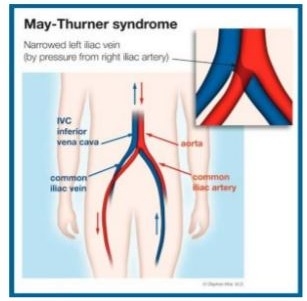
May-Thurner Syndrome is an anatomical abnormality in which the Left Iliac Vein is compressed by the Right Iliac Artery.
Why does May-Thurner Syndrome Matter?
Veins carry blood at much lower pressures than arteries. With the Right Iliac Artery so close, the Left Iliac Vein can be easily obstructed. Even partial obstructions can cause issues. Partial obstructions of the Left Iliac Vein increase the risk of clot formation, particularly for patients who are immobilized (Post-operative, long plane flights, casts).
Treatment for May-Thurner Syndrome
Most May-Thurner patients are asymptomatic and neither diagnosed nor treated. If a patient develops a deep venous thrombosis, they may be referred to a vascular surgeon for further evaluation, which is usually when May-Thurner is diagnosed. Sometimes it is found when evaluating a patient for chronic LEFT leg swelling.
Deep Venous Thrombosis Treatment in May-Thurner Syndrome
A deep venous thrombosis or DVT is a blood clot in the venous system. DVTs can be much more serious in May-Thurner patients, as they are larger, cause more swelling, and may be more likely to cause Pulmonary Embolism. In addition to hospitalization and anticoagulation treatment with Heparin (A blood thinner), these patients often require a stent to be placed in their Left Iliac Vein. The reason they eveloped a DVT was due in large part to their unique anatomy. The stent helps keep the vein open and prevents the formation of future DVTs. Sometimes a patient receiving a stent will be put on an anti-platelet medication like Plavix for three months, and often is maintained on baby aspirin (81mg) for life. Lifetime followup of the stent with yearly ultrasound is also recommended to make sure the vein is not narrowing down again for any reason.
Read More from CardioVascular Institute of The Rockies
Who Is Most at Risk for Fibromuscular Dysplasia?
Keeping your blood vessels healthy is one of the most important steps you can take to live a long, healthy life. Along with eating a
What are the Complications of Endovascular Aneurysm Repair?
When your blood vessels aren’t healthy, your overall well-being is put into jeopardy. In fact, many vein and artery conditions can lead to life-threatening complications,
Can a DVT Go Away on Its Own? What You Need to Know
Being diagnosed with a blood clot can be a scary experience. While some blood clots are a normal part of your bodily function and will
What Does Claudication Feel Like? Causes and Symptoms
What does claudication feel like and what are the most common causes? When your arteries are not healthy, your overall quality of life can be
Geniculate Artery Embolization (GAE) for Knee Pain Relief
By Monika Neale, MS III GAE – POSSIBLE NEW SOLUTION FOR SOME KNEE PROBLEMS The network of the geniculate arteries comprises six arteries that supply
Arterial vs. Venous Ulcers of the Lower Extremity
By Monika Neale, MS III The two most common types of lower extremity wounds are venous and arterial ulcers. Although they may look and sound