
Authored by: Leah Lieber, OMS III and Bryan Kramer, MD
Compression Stockings for the Treatment of Chronic Venous Insufficiency
Overview & Indications
- Compression stockings are widely used to improve symptoms for patients with Chronic venous insufficiency (CVI).
- Patients with CVI have lower extremity vein abnormalities that lead to venous dilation.
- Common symptoms include varicose veins (torturous, swollen blood vessels), leg heaviness, calf pain/aching, leg swelling, and skin irritation (can include itching, tightness, discoloration and/or ulcerations).
- The goals of treatment in patients with CVI are reduction of discomfort and pain, reduced swelling, improvement in skin, and healing of any ulcers.
- Stockings are the best treatment to prevent skin damage and ulceration caused by CVI.
Compression stockings/socks
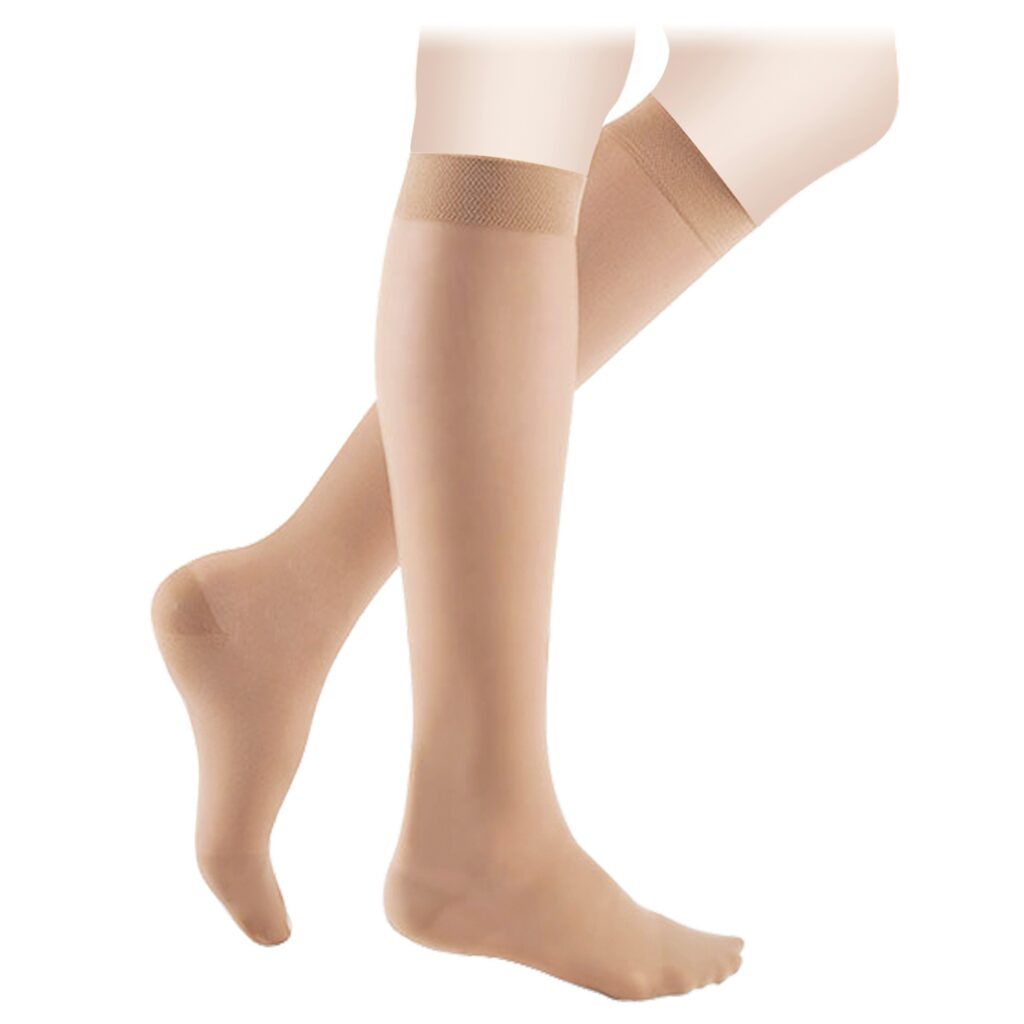
- Compression stockings are long, elastic socks that apply gentle pressure to your legs and ankles, promoting blood flow from your legs up to your heart. They prevent blood from pooling in the veins in your legs.
- Compression stockings are available in five different pressure gradients: <20, 20 to 30, 30 to 40, 40 to 50, and >50 mmHg.
- Compression stockings used for treating CVI need to exert a minimum of 20 to 30 mmHg pressure.
- Compression stockings also come in a a variety of lengths, including knee-high, thigh-high, and waist high. Knee-high stockings are sufficient for most patients.
- Patients can be given a prescription for compression socks and fitted at stores, but compression socks can also be ordered online, and often for a better price.
- Compression stockings are stiff and should be put on while sitting in a chair with firm back support to lean against. Slip your foot into the stretched socking and progressively roll it up your leg. A Stocking Donner can help those struggling to get the socks on. Compression stockings should lay smoothly against the skin and should not bunch in any areas. Stockings should feel snug, but not painfully tight.
Care of Compression stockings
- Stockings can be hand washed, or machine washed on delicate cycle. However, they should not be machine dried, as the heat will destroy the elastic fibers.
- The elasticity of the socks diminishes with time and washing. In order to maintain proper compression, stockings should be replaced every six months.
Citations:
UpToDate
Healthline.com
Read More from CardioVascular Institute of The Rockies
Who Is Most at Risk for Fibromuscular Dysplasia?
Keeping your blood vessels healthy is one of the most important steps you can take to live a long, healthy life. Along with eating a
What are the Complications of Endovascular Aneurysm Repair?
When your blood vessels aren’t healthy, your overall well-being is put into jeopardy. In fact, many vein and artery conditions can lead to life-threatening complications,
Can a DVT Go Away on Its Own? What You Need to Know
Being diagnosed with a blood clot can be a scary experience. While some blood clots are a normal part of your bodily function and will
What Does Claudication Feel Like? Causes and Symptoms
What does claudication feel like and what are the most common causes? When your arteries are not healthy, your overall quality of life can be
Geniculate Artery Embolization (GAE) for Knee Pain Relief
By Monika Neale, MS III GAE – POSSIBLE NEW SOLUTION FOR SOME KNEE PROBLEMS The network of the geniculate arteries comprises six arteries that supply
Arterial vs. Venous Ulcers of the Lower Extremity
By Monika Neale, MS III The two most common types of lower extremity wounds are venous and arterial ulcers. Although they may look and sound